

Chapter 3
Risks and opportunities for your learning
13 min read
You can use generative AI to undermine your learning by outsourcing all your thinking to it. But you can also use it to strengthen your learning. It's a tightrope to walk.

#3.1How learning works
Learning is not just a matter of receiving information. Your brain does not work like a hard drive where you store files. You build knowledge by engaging actively with the material: tackling a problem, getting stuck, trying again, and connecting it to what you already knew. Struggling with a concept, rewriting a paragraph, or working through a line of reasoning yourself helps new knowledge stick and lets your skills grow.
Researchers call this constructive friction: the productive resistance that causes your brain to store information (in so-called schemas) in a way that makes it usable for you (Vermunt & Verloop, 1999). Think of this, on the one hand, as automating your thinking (for example, being able to recite the 10 times table automatically) and, on the other hand, as the ability to connect very different concepts right away. This is a well-supported finding from decades of educational psychology research (Bjork & Bjork, 2020).
#3.2The risk: cognitive offloading
Generative AI can remove that constructive friction and in doing so hinder learning or even undo it entirely. When you hand over tasks that are actually part of your learning process to AI, researchers refer to this as outsourcing your thinking or cognitive offloading (Lodge & Loble, 2026). Or worse, cognitive outsourcing (Kirschner, 2026). The mental work shifts from you to the system. In the short term, that saves time. In the long term, you do not develop the skill in question, or you may even lose it; a process that Braverman (1974) called deskilling. There could, however, also be upskilling for people who previously could not perform as well without the new technologies, or reskilling for people who had to learn to do different things because of those new technologies (Crowston & Bolici, 2025).
Writing is a good example here. Writing is something you really have to learn. Starting in elementary school, you learn letters, build vocabulary, study grammar, spelling, parts of speech, paragraphs, and longer texts, learn to recognize genres, and learn to write in them yourself. Writing is also not just a way of putting thoughts on paper. It is a thinking process in itself: some of it happens automatically based on what you learned in elementary school and high school, but on top of that you organize, make choices, discover what you do not yet fully understand, and figure out how you want to express it better. Research by Kosmyna et al. (2025) showed that students who used AI without guidance for writing tasks showed less brain activity, produced more uniform texts, and were less able to reproduce the content of their own text afterward. It simply was no longer their text.
The same risk exists with other academic tasks: finding and evaluating sources, formulating a research question, reasoning through an ethical dilemma, and analyzing data. If you do not do those things yourself, you do not practice them. And if you do not practice them, you do not build the skill.
#3.3Self-Image, Procrastination, and Generative AI
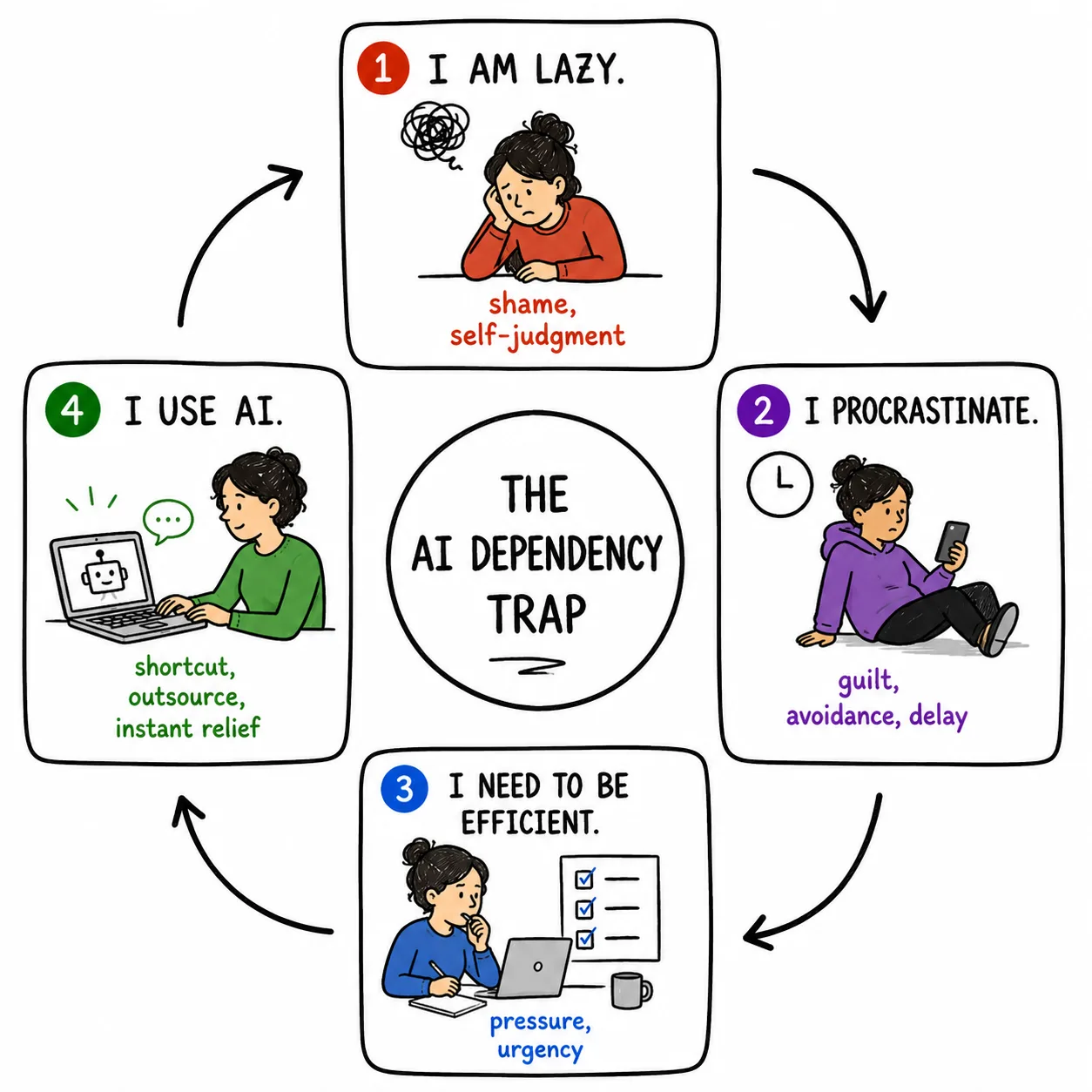
The circumstances in which you use AI also determine whether you learn from it. When you have unlimited access to an AI system and no one is watching - for example, at home rather than in class - there’s a good chance you’ll use the system as a “one-size-fits-all” solution rather than as a tool for learning. As a result, you learn very little. Personal circumstances also play a role. Students who experience significant time pressure and academic stress are more likely to turn to generative AI, and that use is associated with more procrastination and lower grades (Abbas et al., 2024). Those with low self-confidence are also more prone to procrastination (Steel, 2007) and seem to become dependent on AI more quickly (Zhang et al., 2024). This can create a cycle in which procrastination, stress, and AI use reinforce one another. The Center for Teaching and Learning at the School of Business and Economics (VU Amsterdam) recognized this pattern in conversations with students and depicted it in an (AI-generated) illustration: the AI dependency trap.
#3.3.1It is not necessarily all black and white
At the same time, the image of students lazily leaning back while their essays are generated for them is also a major exaggeration. Preliminary research by Law (2026) showed that in practice students use AI in more nuanced ways than is often assumed. They use AI to test ideas, break through a block, or explore a rough first structure. But after that, they make the substantive choices themselves, rewrite the language, and correct where the AI falls short. AI as a sparring partner, not a ghostwriter.
In addition, generative AI typically produces too much text, and it is often too general and too polished. Students who recognize that know that editing and shortening AI output also takes time and thinking effort. As the writer's saying goes: "writing is cutting." So the question is not so much whether you use AI, but how. And whether that use supports your learning process or bypasses it.
#3.4The opportunities: AI as a learning tool
Despite all the warnings in the previous section, it is also true that you can strengthen your learning process if you use generative AI in the right way. The key principle is that you remain the one doing the thinking and AI remains in a supporting role. This is sometimes described as hybrid intelligence (Järvelä et al., 2025).
- For example, you can use AI to quiz yourself: ask a chatbot to give you exam questions about the material and answer them yourself, without help.
- You can also use AI as a critical reader of your own work: write your own text first, then ask AI what is logically missing or incorrect, and then decide for yourself whether that criticism is valid. Have AI suggest an alternative structure for your argument, or offer a surprising perspective on your topic, and then decide for yourself what to keep and rewrite.
- Another effective approach is to use AI to explain difficult concepts: have it explain a concept in a different way than the book does. You use it as a sparring partner. Then try to describe for yourself what you have understood. If you can do that, you know you really get it. This kind of "thinking about how you learn" when using generative AI stimulates critical academic thinking and helps knowledge stick (Luckin et al., 2022).
Google's Gemini Notebook (see Box 3.4) is an example of a tool specifically designed to support learning and research. You upload your own study materials, such as lecture notes, articles, or excerpts from books, and can then ask targeted questions about them. Because the system answers only on the basis of the sources you added, the chance of hallucinations is smaller than with general chatbots. Be careful, though: you still need enough prior knowledge yourself to judge whether the answers are correct (Ainsworth, 2008).
#3.4.1How do you know when your AI use is helping you to learn?
A first practical question to ask yourself before you use AI is: later, without AI, would I be able to explain what I learned here? If the answer is no, you may still manage to produce something, but you probably will not learn much from it. Very little knowledge or skill will stick.
A second question is: is doing this task itself part of what I need to learn? If the answer is yes, it is wise to do the task yourself first, even if it is harder. Only after that should you use AI to improve, check, or deepen your work.
#3.5Generative AI and academic integrity - how do you use it responsibly?
#3.5.1What is academic integrity in the AI era?
Closely related to learning is being able to show that what you have learned or written genuinely belongs to you. This has to do with academic integrity. Academic integrity is about honesty, transparency, responsibility, and acknowledging other people's work. Traditionally, this mainly meant: not having others do your assignments for you, not plagiarizing, taking your exams yourself, and citing sources correctly. In the AI era, a more complex layer is added. Because what if you had text generated by an AI tool;is that still your work?
#3.5.2How do you use AI with integrity?
First, within a course or degree-program context, make sure you know the rules the instructor has set for the course and follow them. And outside that? For professional or academic work? A good rule of thumb is: use AI the way you use a book. Learn from it and use it as a reference, but do not copy its text verbatim without citing it.
You can also use AI as a learning partner. For example, ask for explanations of difficult concepts or practice with quizzes as described in the VU teaching tip on ChatGPT as a personal tutor. That is one way AI helps you learn better instead of undermining the learning process.