

Chapter 7
Generative AI and Assessment
36 min read
The combination of generative AI and assessment presents us with a wicked problem: not solvable without always compromising somewhere, while we remain unsure about the outcome.
The main question for higher education institutions, examiners, and teachers is how we can assure that diplomas are granted to their students based on what students have learned and are capable to do at an individual level. That they are judged for their personal achievement, not the attainment of the generative AI used.
Before diving into this matter, we first discuss what the role of assessment is in higher education (apart from what already has been said in paragraph 4.1) and the added perspective of the last decades, and stretch it out into the era of generative AI.
#7.1Two perspectives on assessment
The first perspective about assessment is the classical measurement perspective, originating from the beginning of the 20th century. Back then, the US developed measurement instruments to select army personnel (Yerkes, 1921) and described for example by Clauser (2021): assessment focusses on statistical methods to assess and improve accuracy in decision-making for pass-fail decisions, selection, and grades. Validity is a technical concept expressed in terms of coverage of content, coverage of content over cognitive taxonomies, and predictive validity for future tasks. This is the world of psychometrics. It focusses on tests being administered under supervised conditions and students working without any technical aids in time constrained situations to measure cognitive ability or attainment.
The second perspective is called the educationalist perspective. This perspective is not new and was already discussed in 1979 by Robert Ebel (1979). In this perspective, the focus lies on using tests and assessment to measure meaningful educational achievements and inform instructional decisions at the program and classroom level. But also, to prepare students for their future professions and life. A conceptual framing for this view stems from Black and William (1998) as well as Earl (2003) as they coined the concepts Assessment For Learning, Assessment As Learning and Assessment Of Learning. In this perspective, all forms of student activity, tasks, and assignments are considered instruments. Instruments to engage learners and provide feedback to teachers and learners about the progress of their learning towards personal goals and impact of their learning, for their future profession and for their lives (emphasizing these forms of validity).
Assessment For Learning emphasizes so-called whole tasks and processes surrounding it to promote engagement, while Assessment As Learning emphasizes whole tasks and processes to primarily learn from. A whole task is a small but complete authentic task in which students have to combine knowledge, skills and judgment as they would in professional or academic practice, rather than practicing isolated components (Van Merriënboer & Kirschner, 2018). Whole tasks are authentic: it resembles what a professional or researcher actually does, for example diagnosing a patient, writing a policy advice, or setting up and reporting a small study. Further, the task requires the coordination of knowledge, skills and judgment, including the routine and the non-routine aspects. Finally, the task is complete: the student goes through the full cycle (orient, plan, execute, evaluate) rather than practicing one step.
The tasks provided in these two forms of assessment perceive validity mainly from the perspective that they reflect tasks students will encounter in their future the professional or personal life.
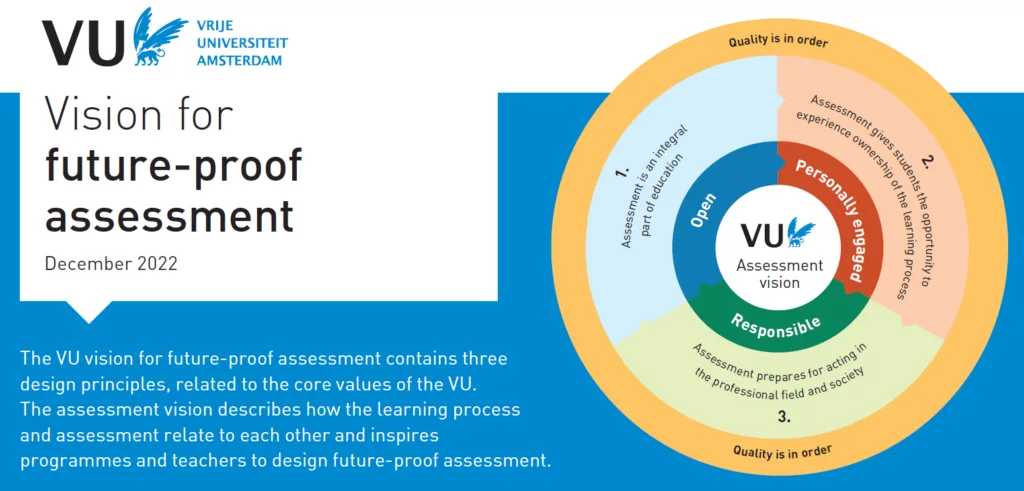
Finally, Assessment Of Learning emphasizes the more classic psychometric perspective on learning. In more curricula development projects, often through (central) educational policies, the shift is towards more emphasis on Assessment For and As Learning. This is exactly in line with the vision on education and vision on assessment of VU Amsterdam.
Does this mean that all classic tests (exams) must be dismissed? No, certainly not, as there are many nuances and disciplinary differences. We will dive into them in the next sections.
#7.1.1Assessment practices for the two perspectives
In all disciplines, as we have seen in paragraph 6.1, it is imperative that students have and should build knowledge and skill upon a prior knowledge base. Such a prior knowledge base is often called foundational or core knowledge. Though these knowledge bases are quite different between disciplines (e.g. the difference between ‘natural sciences’/well-structured knowledge domains versus the social sciences and further to humanities sciences/ill-structured domains (Donald, 2002; A. Jones, 2015; Neumann, 2001) they are imperative to learn more elaborate (deep and wide) topics. So, they must be learned during the first period of a Bachelor's or Master's program. The most effective way to acquire this foundational knowledge and skill is through direct instruction, largely both from a teaching and a learning perspective (Kirschner et al., 2006). In this perspective, applying techniques that motivate students to read information carefully, to critically analyze information (see Chapter 6), solve problems carefully in progressive complexity and the use of classic exams remains efficient and effective.
In view of the VU Vision on Assessment, classic instruction and exams should (at least) be complemented with parallel trajectories that introduce students to real-world applications and their personal role in dealing with them. Therefore, it is common that in these first periods students also already work on small but authentic problems, projects, and research. This is important as it will let students experience directly what the foundational knowledge is used for in future professions and science. Such authentic tasks also stimulate students to learn about their learning gaps, metacognitive skills and development of more general academic skills (such as collaboration skills and communication skill). This will also feed into the new emerging taxonomic ideas around learning as described in paragraph 3.1 that it is a messy process and generative AI changes this to a certain extent. In the first Bachelor phase, these authentic tasks must but limited in complexity (to avoid destructive friction). During the progress of the program, less time can be devoted to learning foundational knowledge and more time can be devoted to learn more specialized knowledge or work on these authentic tasks with an increasing scope and complexity (for example, becoming less structured).
#7.1.2Impact of generative AI
Second, the impact of generative AI on measuring an individual’s achievement for these different teaching and learning methods varies. We can safely say that every task a student must perform without direct supervision is prone to cognitive off-loading (see paragraph 4.4). Think about tasks that students work on or solve outside class-time. So, this is the case for smaller problem-solving tasks, more elaborate tasks such as case analysis or larger tasks such as writing essays or doing projects, take-home exams and research work: indeed whole tasks.
Though many teachers may prescribe various levels and applications of use of generative AI (for example only for spelling and grammar or for generating ideas), in practice it will be unfeasible for teachers to know and check in detail if students stick to these policies. This effect increases when grades are given to students for these tasks and students feel an increased pressure to perform well. Certainly, if students suspect or know that fellow students use AI (and might not be ‘caught’ and hence radiate negatively to their personal relatively weaker product) could negatively impact their scores. A culture of ‘policing’ and ‘fear to be unjustly ‘caught’’ for cheating is most likely the result.
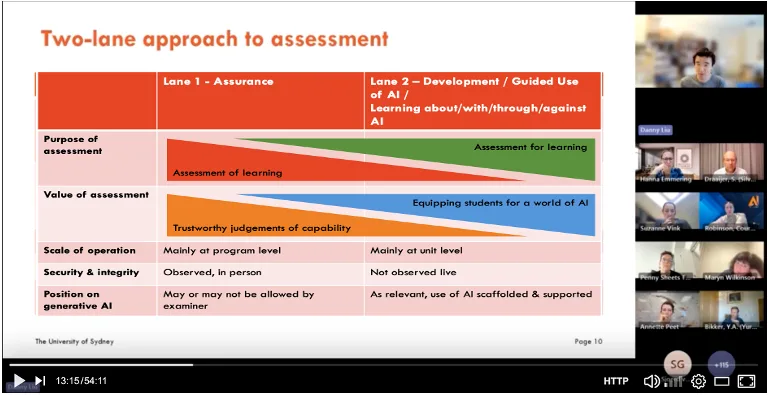
At least, that is the conviction of Liu and Bridgeman of the University of Sydney (2023). Liu has a worldwide influence on thinking about the impact of generative AI on Assessment in higher education and coined the Two-lane approach (2023). Liu acknowledges first that when students work on assignments at home (like case studies, problem-solving cases, essays and take-home exams ) without supervision, it is practically impossible to verify whether they're working entirely independently or using generative AI to any extent. This isn't a new problem in itself; students could previously receive unauthorized help from friends, parents, paper-mills or ghostwriters. Although this problem is common (Christensen Hughes & Eaton, 2022; L. R. Jones, 2011), it still appeared manageable. These forms of assessment were never forbidden despite their risk of violating academic integrity. It remained however a manageable risk for programs, provided the usage isn't widespread and systematic, and lecturers and examiners maintained oversight.
However, generative AI applications belong to a different category. This form of AI can solve problems, generate code, generate well-thought-out, well-formulated and structured content with almost no limitations and be undetectable at the same time. These applications are widely available, cheap (or free) and are already being used extensively by students, including for other tasks such as graphic design, creating summaries, asking questions about the material, or reviewing papers for structure and spelling.
#7.2The two-lane approach
Liu and Bridgeman (2023) devised the two-lane approach to address this challenge.
The guiding principle is that education must equip students to participate ethically and actively in a society permeated by AI. They therefore suggest that it's unnecessary to choose between, for example, abolishing homework assignments or letting everything slide. Instead, they propose that a good curriculum or course balances the two assessment perspectives: Assessment of Learning and Assessment for/as Learning (Black & William, 1999). Generative AI can play a role in both assessment perspectives. Validity must in their view prevail over cheating prevention (Dawson et al., 2024). Liu and Bridgeman describe curriculum and course design as a combination of elements from two lanes. It is the role of the curriculum designer and the teachers to select teaching and assessment methods from these lanes in an orchestrated manner fitting with their context. You'll read more about this in the next paragraphs.
#7.2.1Lane 1 – Assessment of learning
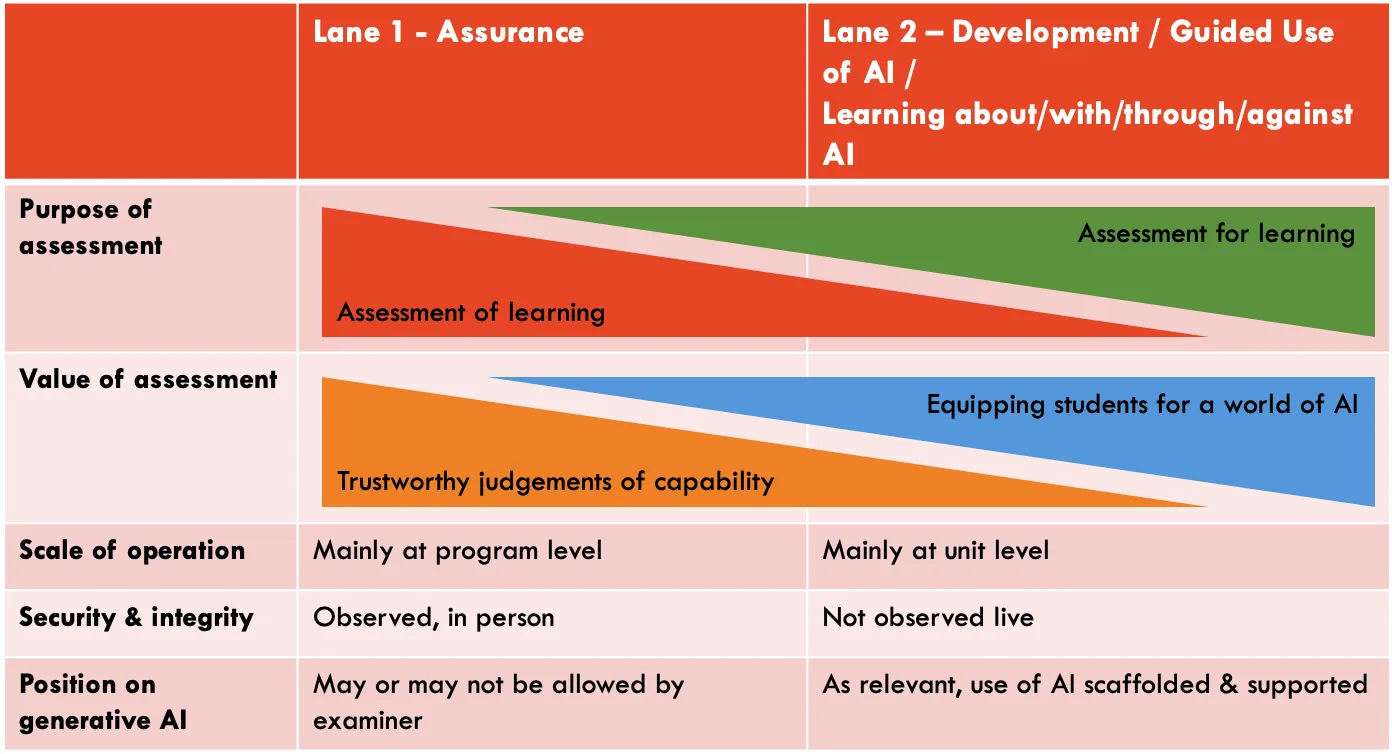
On one hand, programs, lecturers, and the professional field need to be able to determine what students can do independently with regard to knowledge accumulation and skill. This involves Assessment Of Learning, or: extra safeguarding of learning verification under live physical oversight. This forms the first 'lane'. This requires supervision, where students must present and respond to questions from lecturers or examiners directly from their cognitively accumulated (automated, broad, deep) knowledge base. These assessment forms include exams, presentations, interviews, defenses, and poster presentations. The use of generative AI isn't necessarily prohibited here. A student might need to demonstrate their competence in using generative AI, whether in combination with an assignment or test. But in other words, again: classic exams and orals must remain part of the assessment landscape.
#7.2.2Lane 2 – Guided use of AI
On the other hand, students must learn to harness the opportunities of generative AI while understanding its limitations and using it responsibly. This approach centers on Assessment for and as Learning, where teachers guide students in using generative AI productively and ethically. Generative AI is viewed as an integral part of students' toolkit, both during their studies and in their future professional lives. The task of the teacher is to guide and coach students in productive and responsible use.
Through instructor and peer guidance, prompt engineering practice, critical analysis, discussion, and emphasis on academic integrity, educators maximize student learning via assignments and, at VU Amsterdam, through 'Formative Dialogue’.
Student activities and outputs in this lane contribute to the final assessment of acquired competencies, including responsible AI use. For lane 2, Liu suggests teachers to inform and guide students on the proper, responsible and effective use of AI (not prohibiting it). He makes a comparison with a menu in a restaurant that students can use and that can be tried out for fit with the task at hand. The choice is determined by the learning objectives that can (partly) be derived from AI's place in life and future work. Below you'll find an example of such a menu.
| Category | Items |
|---|---|
| As a critical friend – Soups | Suggest analyses, Provoke reflection, Provide study/organization tips, Practicing |
| Getting started – Entrees | Suggesting structure, Brainstorming ideas |
| Engaging with literature – Bread service | Suggesting search terms, Performing searches, Summarizing literature, Identifying methodologies, Using AI driven research tools, Using specialized genAI advice tools, Explaining jargon, Fixing reference list |
| Generating content – Mains | Writing some/lots of text, Making images, video, audio, Making slide decks |
| Analyses – Lighter mains | Performing analyses of data/text, Generating code (Python, R etc.), Generating graphs, Automate tasks, Suggesting counterarguments |
| Editing – Coffees | Editing tone, Improving clarity and readability, Fixing grammar, Shortening |
| Feedback – Desserts | On all of the above elements, Specifically on rubric criteria |
#7.2.3How to use results of lane 2 assessment
It's also important to note that the Two-lanes are not similar in meaning like summative and formative assessment. Summative assessment is often regarded as giving grades and most often under monitored conditions (such as exams) but also giving grades to tasks or assignments. Formative assessment is often regarded as providing feedback but not giving grades and emphasizing student’s personal responsibility in doing tasks and information processing as an inherent, intrinsically motivated effort. Summative assessment and formative assessment however have a place in both lanes of the Two-lane approach: it is not a one-on-one relation. To arrive at a thorough and comprehensive final assessment of the student’s competence, there are two options for lane 2 assessment:
1. You can and should (according to Liu) still include the results from lane 2 assessments in the total final grade in summative sense. However, these assessments should carry relatively less weight in the final grade than traditional assessments. The amount of weight reduction is dependent on the risk invoked by the particular assessment.
2. However, lane 2 assessments can also be used as a formative assessment only, without counting towards the final grade. In that case, the effort and outcome of this lane 2 assessment are implicitly reflected in the result of the summative assessment. This use of lane 2 assessment is in line with the formative dialogue as promoted in the VU vision on Assessment.
#7.2.4Orchestrating Lane 1 and Lane 2
In a curriculum, and in every course, program managers or lecturers must make a well-considered choice about implementing methods from both lane 1 and lane 2. These must be hinged to the discussions and decisions about the learning outcomes as described in Chapter 5. Each course contains elements to directly assess students' knowledge development under controlled conditions, and elements where AI use is allowed or even promoted or obliged to use. In the second lane's implementation of lessons, workgroups, projects and lectures, AI is purposefully taught, used and critically evaluated.
For a thorough final assessment of a student's competency, a program, or course includes judgments from both lane 1 and lane 2. Liu puts forward a ‘new’ list of assessment types as seen in the table below.
| New Assessment types (secure, lane 1) Final exam – secured | Written exam |
|---|---|
| Practical exam | |
| Oral exam | |
| In-semester test – secured | Written test |
| Practical test | |
| Oral test | |
| In person - secured | Interactive oral |
| Practical or skills test | |
| In person practical, skills, or performance task | |
| In person written or creative task | |
| Q&A following presentation, submission or placement | |
| Placement, internship, or supervision – secured | Peer or expert observation or supervision |
| In person practical or creative task | |
| Clinical exam |
New Assessment types (open, lane 2)
| Practice or application - open | In-class quiz |
|---|---|
| Out of class quiz | |
| Practical skill | |
| Inquiry or investigation - open | Experimental design |
| Data analysis | |
| Case studies | |
| Research analysis | |
| Production and creation - open | Portfolio or journal |
| Performance | |
| Presentation | |
| Creative work | |
| Written work | |
| Dissertation or thesis | |
| Discussion - open | Debate |
| Contribution | |
| Conversation | |
| Evaluation |
#7.2.5Notes and implications
The strength of the two-lane approach perspective lies in the model's clarity. It suggests a downsizing of complexity and trade-offs as described in Chapter 4 about The wicked problem of AI in Education, to a dilemma as a manageable task that allows for controlled discussion and implementation. Of course, the model is a simplification of reality. Upon deeper inspection, you'll discover that there will be overlap and many courses are already designed according to the two-lane approach principles. In the graph by Liu, the overlap is expressed in the wig-shapes of the lane 1 and lane 2 characterizations.
Cath Ellis of Western University in Australia even goes a step further in looking at the Two-lane approach (Gallant, 2025). She introduces Western Sydney's Assure and Inspire (AI) Approach to assessment (see figure below), which is their interpretation of the two-lane model.
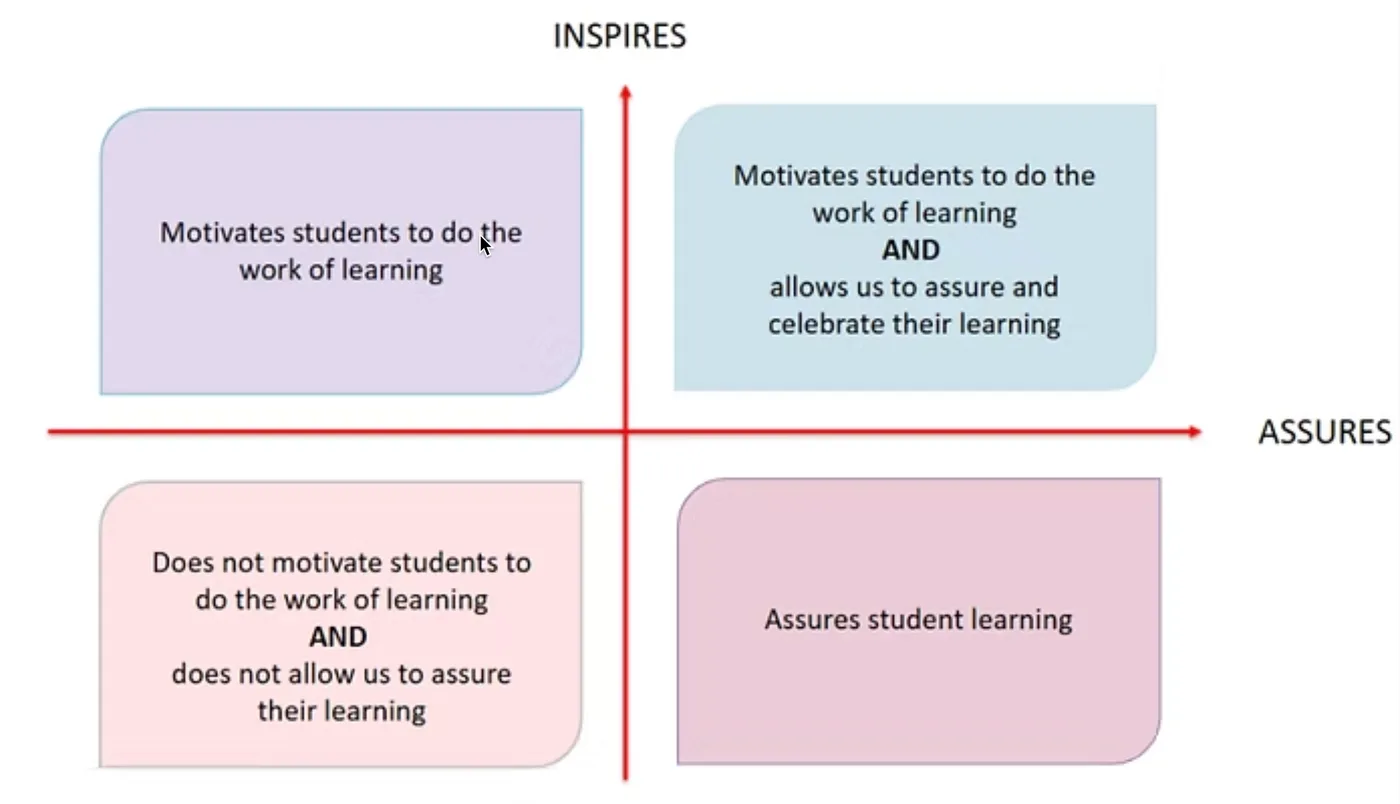
What follows from the two-lane approach and the VU Vision for Assessment is that VU Amsterdam needs no revolutionary change of educational paradigm. It does require programs and lecturers to recalibrate their learning objectives continuously, and to orchestrate the various forms of assessment across a curriculum with care. That is what allows a program to incorporate generative AI defensibly, and to keep guaranteeing the value of the diploma.
#7.2.6Conditions for making the two-lane approach work
Get exam boards and program committees aligned
A first important condition to note to make the orchestration intended by the two-lane approach work, is that exam boards and program committees coordinate their activities and perspectives on what the assessment program must be. It is imperative that the course leaders and the exam boards know how the quality assurance of the assessment program as a whole, leads to a defensible value of the diploma. This way there needs to be no panic about students possibly ‘having ChatGPT write their whole assignment without the teacher spotting it’.
An important additional condition are clear guidelines on how to conduct the in vivo assessments and formative dialogue. Formative dialogue, interviews, discussions, presentations and oral must be conducted well. In terms of the stakes of the activity, it is good to realize they are on a sort of continuum. From activities with no- or low stakes that only focus on the learning, to activities that have medium stakes by contributing a bit to a final grade, up to conditions with high stakes in which the activity determines a large part of the final grade. The higher the stakes, the stricter the guidelines and rules are to make assessment reliable, consistent and traceable. Formally, the latter (oral exam) has the most stringent guidelines that are laid down in the Education and Exam Rules. It requires currently for example that two assessors are present at an oral exam and only the student can ask for recording of the session. For the face-to-face activities that do not carry that much weight, much more flexible formats are possible. But that is often not very clear and exam boards can be strict on rules and easily denote every face-to-face activity that leads to some credit for a final grade to be conducted under oral exam conditions. VU Amsterdam is currently considering publishing a memo with more nuanced guidelines.
Oral assessment and group presentations: a practical walk-through per phase
Oral exams, assessment interviews and group presentations are gaining ground again, partly because they are hard to outsource to generative AI and partly because they show what a student can actually do with the material (Sotiriadou et al., 2020; Theobold, 2021). Lecturers may run them on intuition. That can make them time-consuming, stressful for students and vulnerable to inconsistency and appeal. Table 7.3 Tips for conducting sound assessment using interviews, oral assessment or group presentations. below describes what to arrange in each phase, from preparation to follow-up, and why.
| Phase | What to arrange | Why, and what the literature says |
|---|---|---|
| 1. Preparation | Decide what the oral component is for: a stand-alone summative test, a check on authorship of a written product, or a formative rehearsal. Write this in the course manual, with the weight in the final grade and the rule for absence or failure. Share a short rubric (three to five criteria) two to three weeks in advance. For group presentations, state whether all members receive the same grade or whether individual contributions are weighed, for example via a question round per student or a peer contribution form. Publish a time schedule with buffer slots, book a quiet room, arrange a second assessor or note-taker for high stakes exams (e.g. thesis defense), and tell students what to bring along. Prepare a question bank per learning objective. Do a fifteen-minute dry run with a colleague. Important, if an oral will pose the same (content) questions for, for example, a fixed book, oral assessments are not useful (questions can be shared easily). Use oral assessment to probe students understanding of a piece of work they did. Then you can ask similar questions because they will revolve around the specific student's topic. | Oral assessment varies on six dimensions (content, interaction, authenticity, structure, examiners, orality); deciding these in advance is what makes the format defensible (Joughin, 1998). A standardized assessment instrument and two assessors are the main safeguards against assessor effects such as norm drift, sequence effects and halo effects (Bergwerff et al., 2015; van Berkel et al., 2014). Structured practice opportunities and mock orals improve student preparedness and confidence (Stephenson et al., 2025). For group work, a combination of a group grade and an individual grade is preferred (van Berkel et al., 2014). |
| 2. Starting the session | Welcome the student by name, repeat the procedure (duration, who asks what, when the grade follows) and confirm the criteria are the ones shared earlier. Open with an easy question such as "Take me through your main finding" or "How did you approach the work". Let a presenting group not start on its own terms. Use the technique of pointing out students yourself for presentation of specific parts (so students need to be able to present on every aspect of the work done). Say that you will take notes, so writing is not read as disapproval. | Anxiety lowers performance and therefore validity; a predictable opening is a measurement precaution rather than a courtesy (Huxham et al., 2012; Theobold, 2021). Transparency about criteria and procedure is a formal quality requirement of assessment in Dutch higher education (van Berkel et al., 2014). |
| 3. Conducting the interview or presentation | Follow the rubric or script in your questioning and move from for example reproduction to application to justification: what did you do, why this choice, what would change if. Use silence; give a few seconds before rephrasing. Agree in advance which prompts are allowed (repeat, clarify, narrow) and which are not (giving half the answer). For group presentations: strict timing with a visible timer, then a fixed question round in which each member is addressed by name. If peers assess, use a form with two or three criteria. Separate roles: one assessor leads, the other scores and watches the clock. Swap halfway through the day. | Interactive orals allow assessors to probe reasoning in a way written work cannot, which is their main validity advantage (Sotiriadou et al., 2020; Theobold, 2021). Consistent prompting across students is needed for comparability; unstructured prompting is a known source of unfairness in oral formats (Joughin, 2010). Assessor fatigue and sequence effects are documented reasons for changing roles and order (Bergwerff et al., 2015). |
| 4. Closing | Signal the end explicitly ("two minutes left, anything to add?"). Thank the student, state when and how the result follows, and ask them to leave before you deliberate. For presentations, close the question round and let the group step aside while assessors confer. | A clear closing ritual reduces negotiation in the room and protects the independence of the assessors' judgment (Joughin, 2010). |
| 5. Feedback, oral and written | Give a two to three minute oral debrief shortly after the session if the decision is clear: what went well, what was missing, one improvement point. Keep it descriptive. Follow up with written feedback in the rubric within a week. | Feedback works when students understand what to improve and how; written feedback lets them reread it once the stress has subsided (D. J. Nicol & Macfarlane-Dick, 2006). Feedback from instructors and peers is the most consistently reported facilitator of oral assessment performance (Stephenson et al., 2025; Van Ginkel et al., 2015). Written documentation also protects the assessor in case of appeal (Bergwerff et al., 2015). |
| 6. Grading directly or afterwards | Complete the rubric immediately after each session and deliberate five minutes with your co-assessor. Direct grading and release of grades is defensible for low-stakes formative rounds or a single student. | Grading only after all work has been assessed is a standard assessor instruction in Dutch assessment handbooks because of norm drift and sequence effects (Bergwerff et al., 2015; van Berkel et al., 2014). |
| 7. Follow-up | Evaluating and improving the assessment is the final step of the assessment cycle (Bergwerff et al., 2015). Self-reflection and review of performance also help students; consider recording presentations for later self-assessment (Stephenson et al., 2025; Van Ginkel et al., 2015). |
Below we list a few additional tips.
- Tip 4 — How do you prevent free-riding in group assignments?
- Tip 28 — Constructive feedback? Ten tips!
- Tip 36 — How to develop a rubric
- Tip 49 — How to consider neurodivergent students in your teaching
- Tip 75 — How to support students with autism
- Tip 76 — How to consider students with dyslexia
- Tip 77 — How to support students with ADHD
Technology use by teachers
Another condition is the technology that teachers use. And that is important because the assessment activities in lane 1 places a heavy burden on academic staff. Systems must be in place to record the activities easily and safely. Generative AI makes recording such activities much easier than ever before. Transcripts can easily be produced and - using generative AI - be summarized and stored for later reference. Currently, however, no clear guidelines exist about which technologies can be used formally, how the data is stored etc. Also for those developments, VU Amsterdam is working on additional guidance for staff and applications.
AI tools for students and staff
Finally, higher education institutions must provide a level technological playing field for all students. The variation in AI competencies and availability of technologies is big: students who are less proficient or have less access to generative AI tools must not be disadvantaged compared to students with more access. In lane 2, the institution should have a licensed set of high quality LLMs and tools available for all students. VU Amsterdam has these tools available, see paragraph 2.1.1 to 2.1.4. Clear monitoring and control by programs and IT services is needed on the rapid development of AI in professional software and plug-in applications within every conceivable application. Standard packages are a thing of the past, and safely offering only Copilot or Gemini to students isn't sufficient. This demands flexibility from future-proof IT support organizations and financial space.
#7.3Example: Writing papers and dissertations
It goes without further explanation that dealing appropriately with generative AI in the writing process of papers and dissertations is one of the most challenging tasks.
As an illustration which reflects many aspects of the Two-lane approach, interactive orals and the move from focus on fraud prevention to learning, we will take the course Academic Research Writing (or Capstone) project of the Amsterdam University College. This course is coordinated and supervised by Joost Krijnen and Lotte Tavecchio. As the title of the course suggests, the goal of the course is to learn how to conduct research, with a focus on the writing part.
During the last years, the course coordinators experimented with various options on how to deal with generative AI in that course. They soon realized that, indeed, paying more attention and giving more weight to the process of doing research and writing of the student was imperative. This is needed for a sustainable and defensible judgment about student achievement considering the use of generative AI.
To start with, and to a large extent, the thesis writing and assessment guidelines and process remained unaltered. So, students had to work on a few supporting assignments, as before, and the rubrics for assessing the quality of the final product remained the same, including all the criteria for handing in original and proper use of sources. But a few distinct components were changed, as explained below.
The first important intervention is that the coordinators incorporated a dedicated classroom session on AI and academic competency in learning outcomes in the grading. The classroom session covered the following components:
- An open dialogue with students regarding their usage, experiences, and concerns related to generative AI.
- Fundamental concepts: Providing definitions and explaining what generative AI and large language models (LLMs) are, as well as how they function.
- Critical evaluation: A balanced discussion of the advantages and benefits versus the disadvantages and risks associated with these tools.
- Course policy and responsibility: Clarifying what constitutes responsible use of generative AI and how it relates to university regulations concerning fraud and plagiarism.
- Academic integrity and referencing: Practical instruction on how to correctly reference the use of generative AI using styles such as APA or MLA.
- Practical exercise: A short exercise focused on prompting.
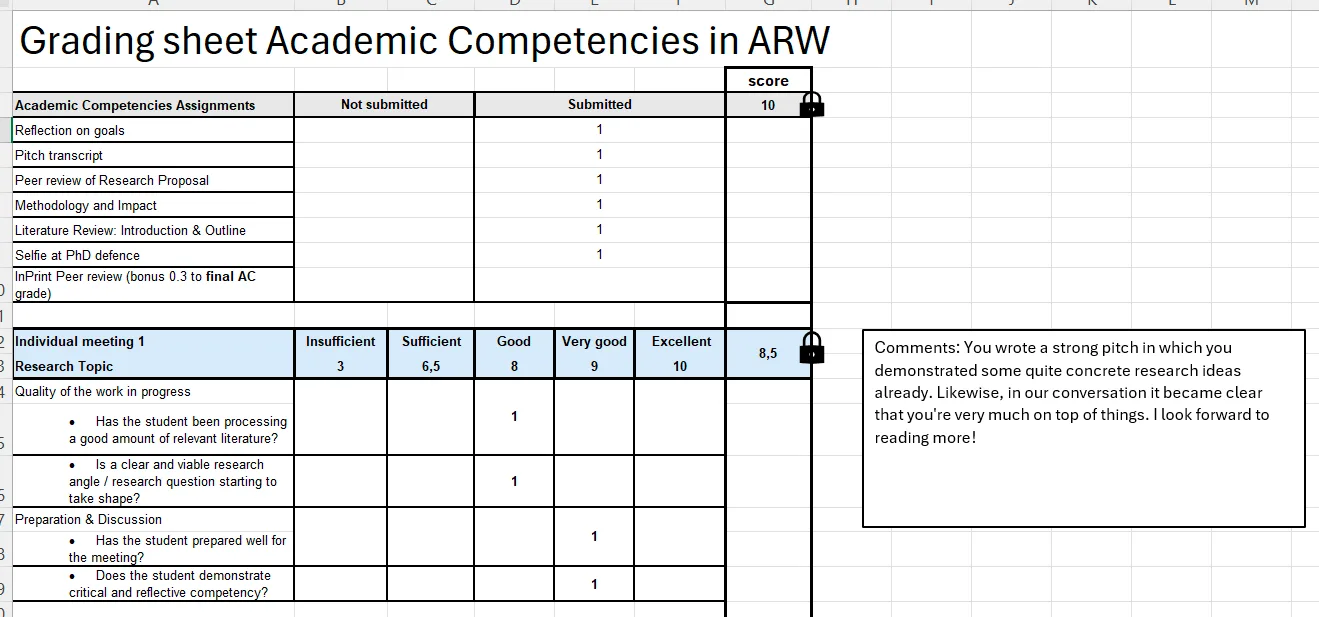
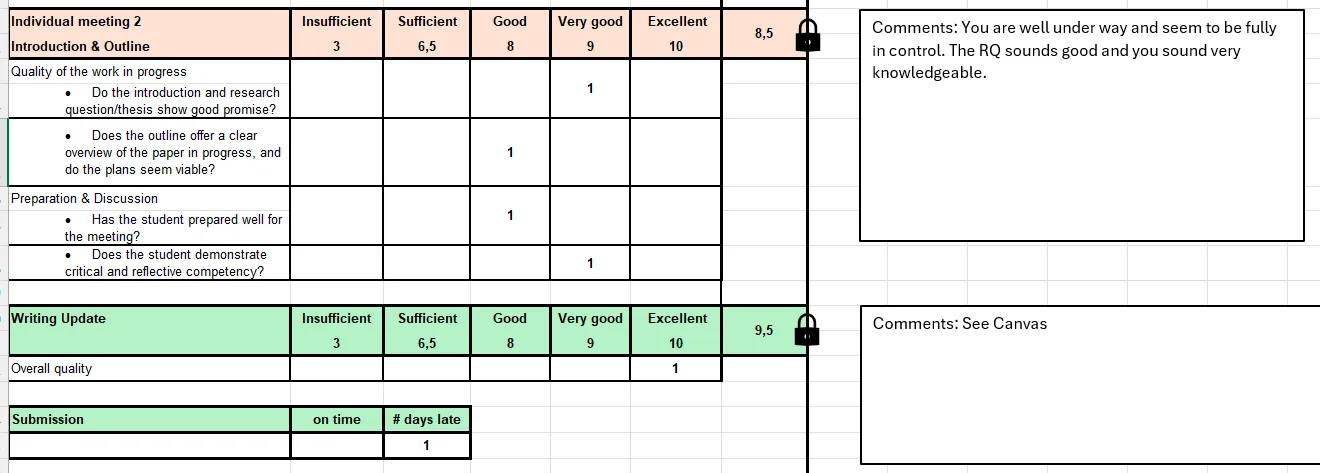
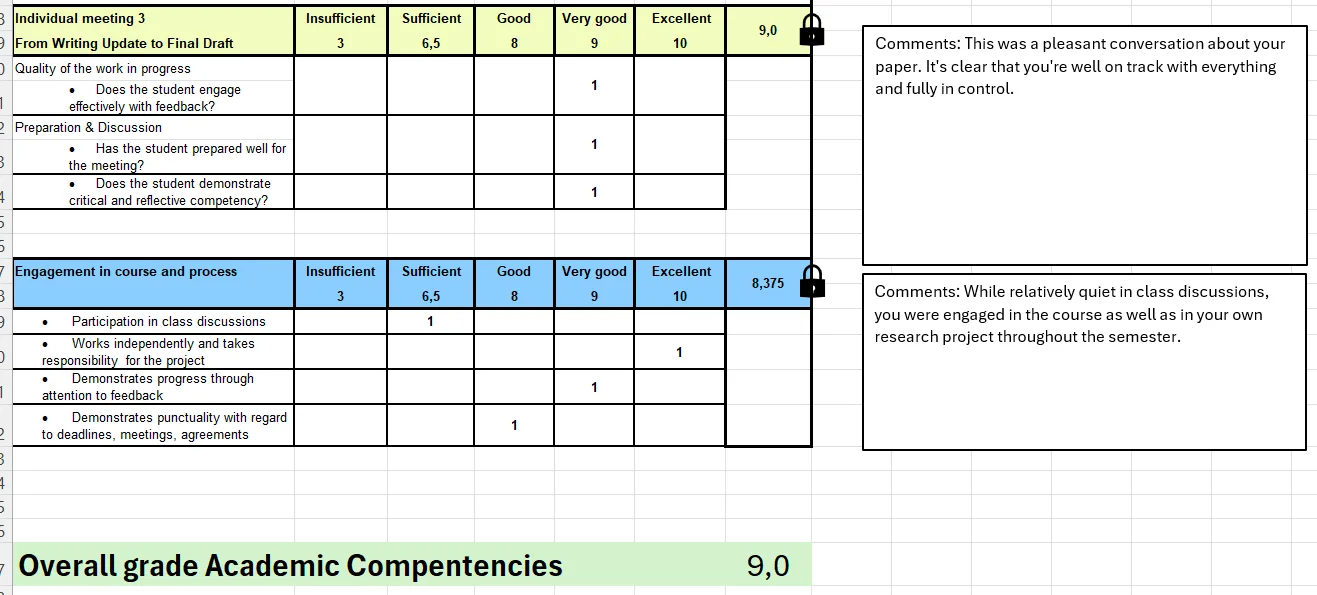
Regarding the academic competency, the coordinators decided to eventually reserve 30% of the final grade for these competencies. Grading for these competencies was done directly, at location, after meetings with a student, and an easy to fill in shared Excel sheet was used for this purpose. The Excel sheet is a simple table with a limited number of criteria and achievement descriptions. A minimum of three meetings are set during the project. The process is that the student hands in their preliminary work a few days before the meeting so the supervisors already have information upfront. Then, one supervisor interviews the student for 15 minutes and directly afterwards fills in the rubric. These sessions are not recorded.
| Criteria | Insufficient (3) | Sufficient (6.5) | Good (8.5) | Excellent (10) |
|---|---|---|---|---|
| Quality of the Work in Progress | ||||
| Ability to Reflect on Selection and Analysis of Sources | Student struggles to explain why sources were chosen or how they contribute to the project. Little to no critical engagement is evident. | Student can explain the relevance of some sources but shows limited ability to reflect on their role or critically engage with them. | Student provides a clear and thoughtful explanation of source choices, demonstrating growing critical engagement. | Student demonstrates deep insight into the selection and use of sources. Critically reflects on their value and limitations in a convincing way. |
| Demonstrable Progress Between Meetings & Ability to Engage with Feedback | Student shows little to no progress since the last meeting. Feedback from the previous session is not addressed or understood. | Student shows some progress. Attempts to respond to earlier feedback are evident but not fully effective. | Student clearly explains how feedback has been considered and used to improve the project. Progress is meaningful and well communicated. | Student shows clear, thoughtful engagement with earlier feedback and has made strong, well-argued improvements as a result. |
| Preparation, Discussion & Engagement with Research Writing Process | ||||
| Level of preparedness for meeting | Student appears unprepared and has difficulty engaging in discussion. Responses are brief or unfocused. | Student is somewhat prepared but struggles to articulate ideas or follow the discussion fully. | Student is prepared and actively engaged in the discussion. Communicates ideas clearly and thoughtfully. | Student is fully prepared, highly engaged, and shows ownership of the project. Actively contributes to a thoughtful and productive discussion. |
| Demonstration of Critical and Reflective Competency | Student shows little to no ability to reflect critically on choices, challenges, or the writing process. | Student shows some reflective thinking but responses lack depth or clarity. | Student reflects critically on key decisions, challenges, and writing strategies in a clear and thoughtful way. | Student demonstrates strong critical thinking and reflection, offering nuanced responses and showing awareness of both strengths and areas for growth. |
| Ability to Work Independently and Take Responsibility | Student demonstrates little initiative and depends heavily on guidance. No clear planning or next steps are articulated. | Student shows some initiative but requires support to move forward. Future plans are vague or underdeveloped. | Student communicates clear next steps and demonstrates growing independence and responsibility for their work. | Student shows strong initiative and ownership of the research process. Clearly articulates goals and next steps, and takes full responsibility for development. |
Thirdly, the coordinators set a policy for the use of generative AI for their course that is not prohibitive. It is acknowledged that students will use generative AI, and the role of the supervisors is to guide student in using it responsibly. The following rules are set in their policy document.
Fourthly, the project finishes with the student giving a presentation of the research done. During that presentation, the student is again assessed on their knowledge about the research, which assures the development and achievement of the individual student.
The combination of the four elements (three meetings, the inclusion of assessing academic competence, the guided use of generative AI and the final interview) makes the course an exemplar of using the Two-lane approach. On the one hand, the assurance of learning is realized by close monitoring and assessing of the individual development of the academic competence in combination with monitoring and discussing the use of generative AI.
A commonly mentioned objection to the approach of AUC is that the intensive supervision and assessment process takes up a lot of time. This is true to a certain extent. During an interview with the coordinators, they, however, argue a different perspective. Firstly, even without the emergence of generative AI, writing processes deserve such a close guidance by supervisors as academic writing is a core activity and competence that students need to acquire. Guidance and feedback are essential for this learning process.
Secondly, the emergence of generative AI requires this approach, as the value of the diploma rests on the program being aware and addressing the ubiquitous presence of generative AI in the professional field and sciences. Finally, they found that students themselves experienced enormous value from their approach: “the approach we have ensures that we really ‘see’ the student and acknowledge their individual struggles and effort. Students also emphasize this in their feedback. They say that this course is where they really feel that they make great strides in their development and feel to become part of the learning and research community.”
So, how can you make this process run as smoothly as possible or with not too big a demand for supervisor time? First, an interesting exercise for any educational program is to calculate the total supervision time for the amount of ECTS realized. It could surface that the supervision time per ECTS is actually limited. Of course, having three supervision sessions in a 6 ECTS project, results in a higher load than three supervision sessions in a 24 ECTS project.
An additional approach is to not let students work alone on their thesis, but work in groups of about 3-4 people. Students preferably work on different topics or research questions. In this way, students can prepare their meetings as a group and as a teacher, you can incorporate peer-feedback processes or deploy self-assessment processes. For example, when a discussion with the supervisors is due in the second half of the week, students can be requested to hand in their concepts in FeedbackFruits on Monday. They can invite their peers to comment on the work and discuss it already on Tuesday, and send their common findings to the supervisors. A good example with detailed guidance of how this can be done is described by dr. Danny Scholten of VU Amsterdam in the following two didactic tips:
- Tip 37: Do’s and don’ts for effective peer feedback - part 1
- Tip 38: Do’s and don’ts for effective peer feedback - part 2
Additionally, the group collaboration and setting the supervision meetings in advance, helps to prevent students can feel alone or isolated when working on their project and that they tend to fall behind in the execution of their projects.
Senior lecturer Sharon Klinkenberg of the University of Amsterdam has an additional approach: “I now organize the writing process via Microsoft Teams, where each student gets their own personal channel. I explain to them how they can use Microsoft OneDrive to access their files within that team. And that's where they get to work. As a result, my role is shifting more towards that of a process supervisor. Students can tag me in their team or documents with short questions. This allows me, as a teacher, to keep a close eye on their progress. For students, the temptation to use AI becomes much smaller – precisely because their process is visible step by step.” You can see how he organizes his process on this webpage.
#7.4Example: Genre writing
Gea Dreschler of VU Amsterdam’s Academic Language Program devised a writing intervention that incorporates the use of generative AI to learn about genre conventions in writing, specifically in academic writing (Dreschler et al., 2025). The task is embedded in a first-year, standalone academic writing course (3 ECTS) that serves as the university’s core activity for teaching scholarly prose. The instructor deliberately chose one slice of the “writing pie” – genre conventions – as the focus for a single, high-impact assignment. By concentrating on genre conventions the course could isolate a concrete, teachable skill set (time management, drafting, revision) while still engaging the broader writing process outlined in the pie.
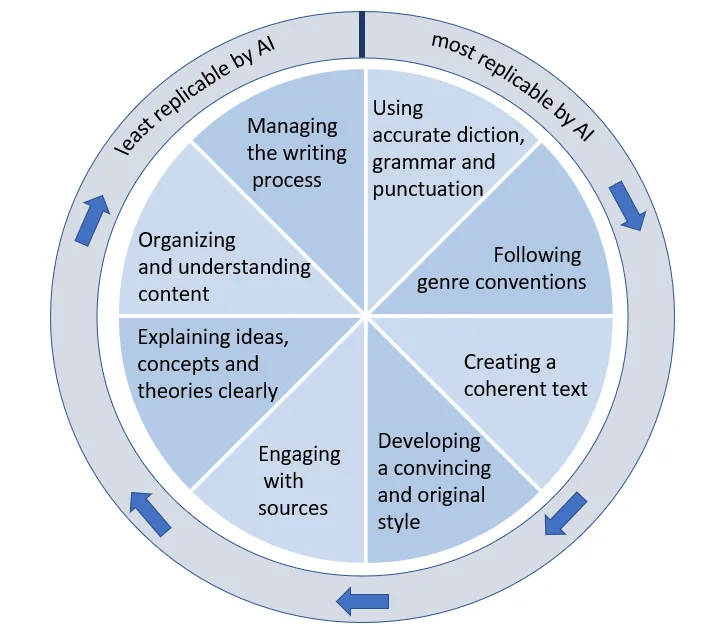
Students are asked to produce a short research paper that explicitly demonstrates mastery of academic genre conventions: clear paragraph structure, appropriate headings, cohesive devices, and a consistent citation style. They begin by planning the outline, then use ChatGPT to generate first draft prose segments that they subsequently edit for register, coherence, and accuracy. Throughout the process, students must manage time, revise iteratively, organize content logically, explain ideas clearly, and engage with sources. These are skills mapped directly onto the lefthand slices of the writing pie. The final manuscript must therefore reflect both the structural norms of scholarly writing and a visible trace of student led revision.
Then the issue of genre is highlighted in the task. Students were given a text with many features of informal writing and slightly adapted it by removing citations, shortening it to a single paragraph and adding some informal features that were discussed in the teaching materials, such as sentence fragments. The teachers then provided the paragraph to ChatGPT 3.5 with a simple prompt:
Could you please increase the formality of this text so that it is more academic in style?
This output was then used in the classroom activity. Table 1 presents some example sentences from the exercise.
| Student Text | Text output by ChatGPT 3.5 |
|---|---|
| On the other hand, the Internet of Everything (IoE) creates lots of opportunities. | On the contrary, the Internet of Everything (IoE) engenders a plethora of opportunities. |
| Not the advertisement that you see in a newspaper, but the one that you will see on smart screens. | However, this advertising does not manifest itself through traditional print media, but rather through the medium of intelligent screens. |
| Have they never thought of tourists who have never been in a major city like New York and would like to drink a coffee at a Starbucks store? No. | Nevertheless, they tend to overlook the needs of unacquainted tourists who find themselves in unfamiliar urban locales, such as New York, and yearn for the prospect of patronizing a Starbucks establishment, for instance. |
The teaching procedure was then as follows. First, the students watched an online recorded video on basic characteristics of formal written English. The lecture focused on what is typically avoided in academic writing (such as vague words, informal phrases and sentence fragments) and what is typical for the genre (such as using standard academic phrases and precise language). Second, the students attended an in-person classroom activity, which covered the topic of academic style. During the activity, the students worked on academic style and formality that implemented ChatGPT.
The classroom activity began with an analysis of an informal student text. Students identified informal features and suggested more formal alternatives. They were then presented with the text edited by ChatGPT and evaluated the suggestions. They identified changes they considered effective or ineffective in terms of formality.
Some of these changes, such as “engenders a plethora of” and “yearn for the prospect of patronising a Starbucks establishment” (see Table 1), raised interesting questions about what level of formality fits the communicative purposes of the genre. Other changes, such as “smart screens” to “intelligent screens,” revealed a potential limitation of using ChatGPT to increase formality in this way. Students argued that “smart screen” is the name of an actual technology, rather than an informal description.
These discussions took place at each stage of the activity, allowing students to receive feedback from each other and the teacher. This feedback helped them determine concrete strategies they can later apply to their texts, aligning with the learning goals.