

Chapter 3
Generative AI and educational design
12 min read
Educational design is the intentional process to design curricula and courses to elicit intended learning behavior by students to achieve intended learning outcomes.
A first way of looking into generative AI and its influence on educational design is going from macro to micro level (King’s College London, 2025). The macro level covers university-wide principles and policies on generative AI. VU Amsterdam has existing guidelines on this topic as described in Framework for Generative AI in Education. The middle level addresses the implications of generative AI at the department and study program level. Several faculties and programs at VU Amsterdam have made their own more specified policies (among them the Faculty of Science, SBE, the Faculty of Medicine and FGB; the first three are described in Section 1.3). Finally, the micro level concerns the use of generative AI within individual courses and by individual academic staff. The central question at this level is how generative AI impacts learning outcomes, how it can support student learning or make teaching tasks qualitatively better or more efficient. Generative AI raises important questions of which the most pressing is how we can ensure that students retain meaningful learning experiences when AI is involved and how can we assess that appropriately and effectively.
Another perspective is the learning orientation regarding generative AI in educational settings:
- Learning about AI means building a foundational understanding of what AI is, how it works, and what its limitations are, as well as their impact on society and learning. Without this base, critical use remains impossible.
- Learning with AI uses AI as a tool in the learning process. For example using personal tutors, role-playing, Socratic dialogue bots and the like. Outcomes are promising but highly context-dependent.
- Learning through AI makes the encounter with AI itself the learning event, for example by having students critically compare, verify, or challenge AI-generated output.
- Learning against AI means deliberately working without it to build the cognitive schemata that AI cannot replace. Genuine understanding develops where AI influence is lowest. A practical example are computer free and AI free workgroups.
- Learning despite AI names the ambient risk: unguided AI use is associated with cognitive offloading, reduced engagement, and poorer recall.
Effective course design requires deliberate choices about when to introduce AI, when to restrict it, and how to make the student-tool relationship itself a subject of reflection. Together, these five modes suggest that no single stance toward AI is adequate. Effective course design requires deliberate choices on these aspects.
For this Companion, Learning How to Use Generative AI, also relates to the ability of teachers on how to use generative AI for application in the educational setting. So, this Companion plays out at meta-level. In order for teachers to design effective courses and instructions, they must have practical AI skills themselves. Also, they must know about learning processes and learning designs in general. Given the ubiquitous presences of generative AI, they must also know how generative AI influences learning, how it influences the content and methods within the discipline they teach. Together these building blocks should lead to the ideal outcome of effective courses and instruction. Represented in a table format, this looks like the following:
| Requirement | Focus Area | Goal |
|---|---|---|
| Practical Skills and knowledge about broader consequences | Personal Competence | Mastery of the tools, methods and techniques, Knowledge of broader impact. |
| Learning Design | Pedagogy | Knowledge of how people learn. |
| Learning Influence | Student Experience | How AI alters the learning journey. |
| Disciplinary Influence | Content/Subject | How AI changes the field itself, both in content or methods. |
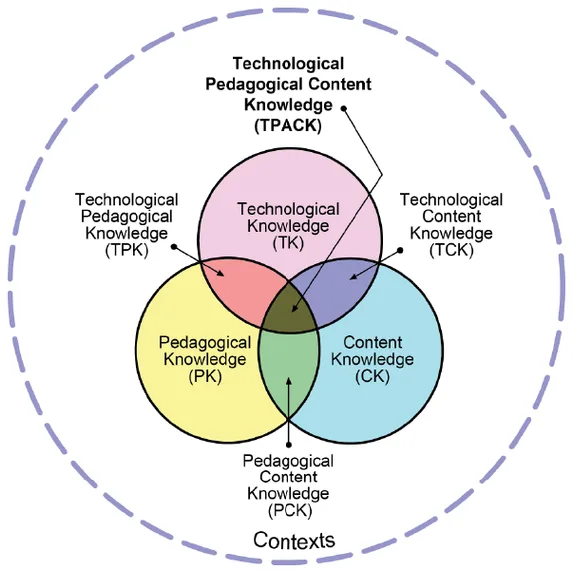
This process can also be represented by the so called TPACK-model (Mishra & Koehler, 2006). The model shows that for an effective pedagogy, teachers need to have knowledge and skills of pedagogy, technology and content. The intersections of these three, now regarding the new and transformative technology of generative AI, presents the challenges that curriculum and course designers and teachers need to address.
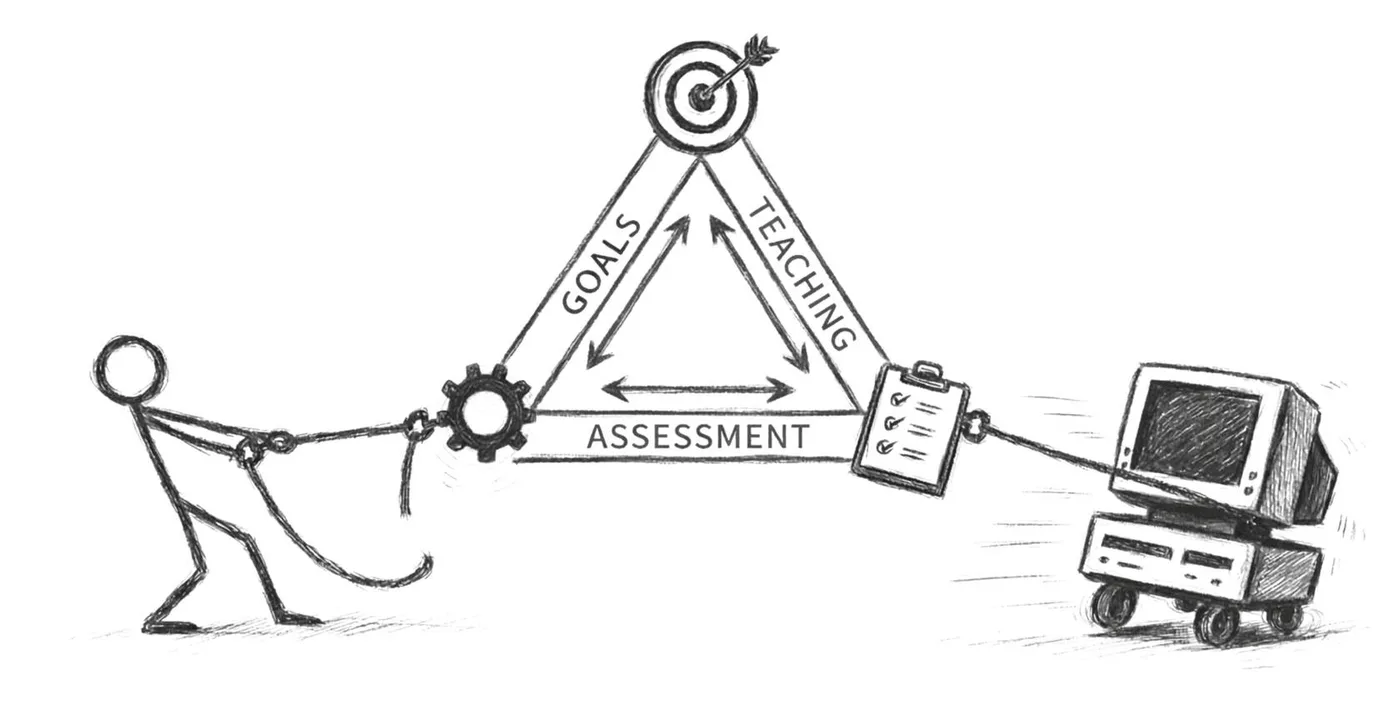
Regarding didactics, this Companion assumes that you as a reader are familiar with the concept of constructive alignment: the principle, introduced by John Biggs (1996), that learning outcomes, teaching and learning activities, and assessment tasks should be deliberately aligned with one another. The core idea is that students learn what they are assessed on, so assessment and instruction must point in the same direction. When generative AI enters the picture, this alignment becomes more fragile. This is because you cannot be certain that, for example, for classic writing assignments, students are actually learning, or using AI. This means that course designs relying on product-based assessment alone are particularly vulnerable. This requires a shift in focus towards the learning process. Still, constructive alignment therefore provides a practical lens for the decisions discussed in this Companion: what should students be able to do independently, but also in combination with the new technology. And how can learning activities build toward that, and what does this require from the assessment program?
#3.1Where does generative AI fit in learning taxonomies?
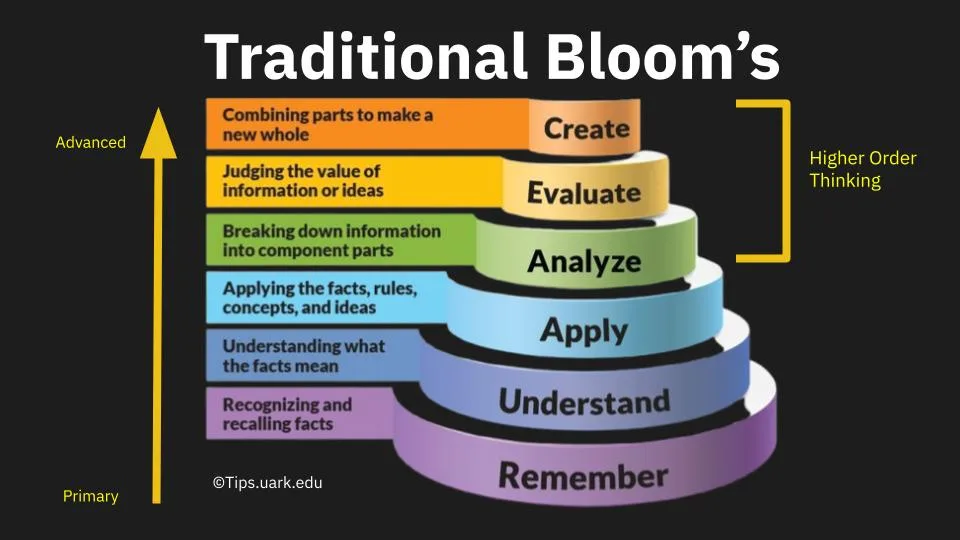
Scholars are trying to work out what kind of impact generative AI has on the taxonomy levels of learning and instruction. Michelle Kassorla (2025) developed an interesting perspective on this. She argues for a so-called ‘inverted Bloom’s taxonomy’. She proposes that the traditional Bloom Taxonomy, that seems to prescribe progressive learning from remembering through comprehension to creating, is fundamentally inverted in the AI era. Her key argument is: "Students now create first, then understand later," reversing the cognitive hierarchy that educators have relied on for decades.
Kassorla begins by clarifying that Bloom's Taxonomy (conceived in 1956) was never meant to be a prescriptive learning framework, but rather a classification system for organizing educational outcomes to be used by educational designers.The purpose was primarily to design instruction and give teachers and designers a clear framework to design learning units and tasks. The taxonomy helps to not over-represent or underrepresent certain task types given the goals of an educational unit.
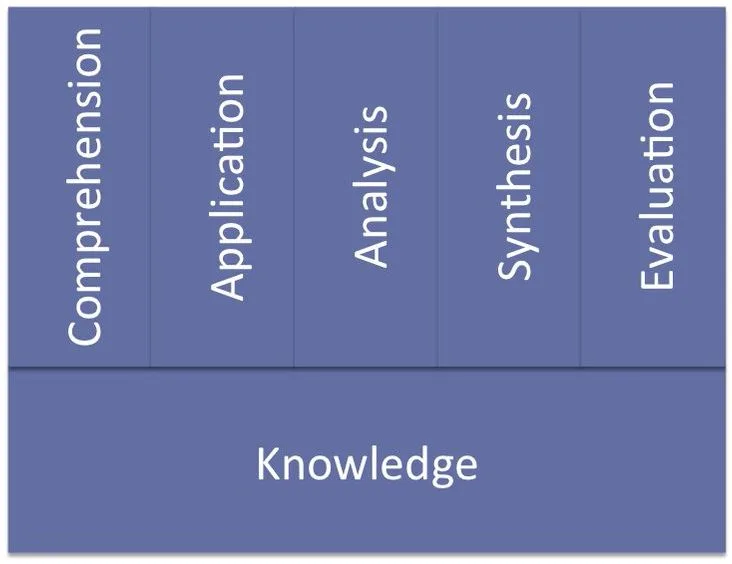
The view emerging from this classification and misunderstood view, however, was that students build understanding linearly from foundational knowledge upward to higher-order thinking skills like analysis, synthesis and evaluation.
This view on acquiring knowledge and skill has already received fundamental criticism. For example, the pyramid visualizing Bloom's taxonomy, was not part of the original framework but added later by an unknown author. And it is precisely this pyramid shape that suggests a form of hierarchy that likely does not exist. Learning is a messy process, and moreover, with the highest level appearing to be the goal of any learning unit. Instead, scholars now suggest that knowledge is a base condition and that different goals (or task types) exist alongside each other (Pedro, 2017; Wiliam, 2017). The concept of higher and lower order in ‘thinking’ in the pyramid actually does not exist at all. Think of learning to ride a bike. You do not first analyze your balance theoretically and then get on. You just ride, fall, adjust, and gradually build understanding through doing. Knowledge and skill develop through each other, not in sequence.
It would be better to see knowledge as something that is basic or automated, but dependent on context. For instance, some students who enter university have basic knowledge of the system. They know what words like 'credit points' or 'examination board' mean, and implicitly understand how and when to email a teacher. This means they don't struggle understanding these basics, like for instance a first generation student might. And so have more cognitive space to actually study, instead of spending energy to decipher the system and culture. This knowledge is so ingrained it has become invisible, and learning it is not a straightforward path through something like a pyramid. See also Box 6.2 on fast and slow thinking systems.
This criticism is further amplified in the age of generative AI because generative AI can seemingly instantly explain concepts and procedures, produce applications and compare theories, dilemmas and solutions, analyzes information and artifacts, and produce creative work. With AI students (seemingly) can skip directly to creation without passing through the stages of remembering, understanding, or applying foundational knowledge. You might think that students miss out on important learning stages this way, or are easily satisfied with AI output. But according to Kassorla the order of learning stages is simply reversed. Students take the output and then go through the other stages after. As educators, it is our task to guide students through these new paths.
In Kassorla's Inverted Bloom model, the hierarchy flips to (from bottom to top): create → evaluate → analyze → apply → understand → remember. Crucially, she describes decreasing agency levels as students move up the hierarchy, as AI assistance is heaviest at the creation stage and progressively lessens as students engage in deeper cognitive work. Each stage builds upon the previous one, but in reverse order from traditional models.
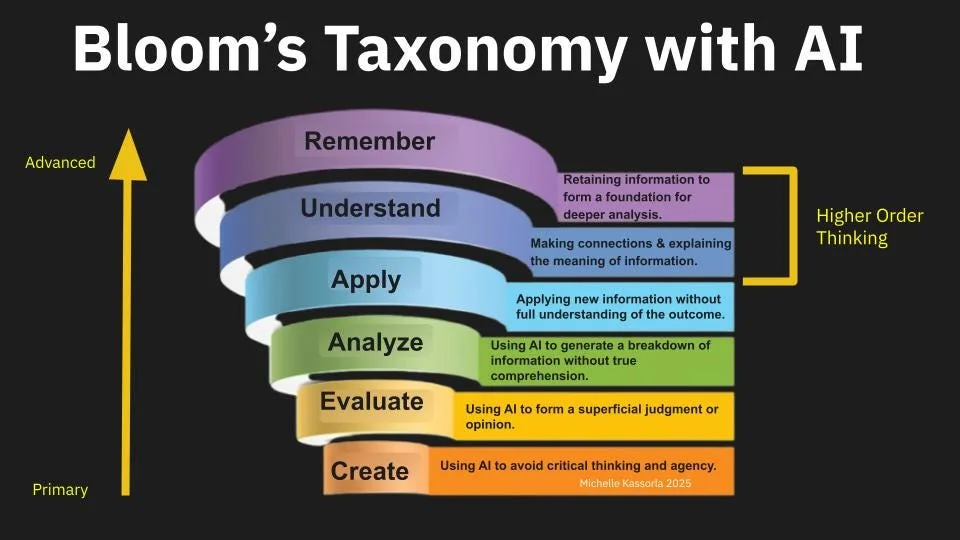
At the bottom tier (create), students have minimal agency; they write prompts and submit AI-generated outputs with little engagement. But then, given good educational design and intent by students, they will need to move up. As a teacher it's an important responsibility to encourage students to gradually take more active roles in their learning: evaluating AI outputs for correctness and logic, analyzing the feedback they receive, applying suggestions to revise their work, understanding why changes matter through reflection, and finally remembering and internalizing principles for future use. Guiding students back and forth between the different levels of learning is an important teacher task.
The critical insight is that genuine learning happens in the upper tiers, where AI's influence diminishes and students' own cognitive engagement increases. So, remembering and understanding are currently seen as the real higher order learning outputs when going from the stage of creating to remembering.
Austin (2026) even goes a step further. She developed UnBlooms™. Her insight is that learning is not a pyramid and does not follow a linear path. She sketches learning as a loop from the top and spiral from the side. It is recursive, nonlinear, and context-dependent. A student doesn’t need to memorize before they can critique. They can enter this cycle at any point. What matters is that they’re doing the thinking, not outsourcing it.
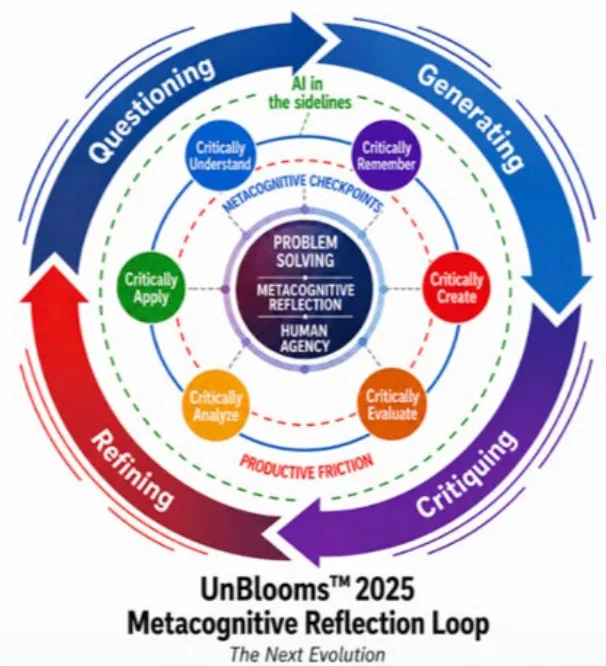
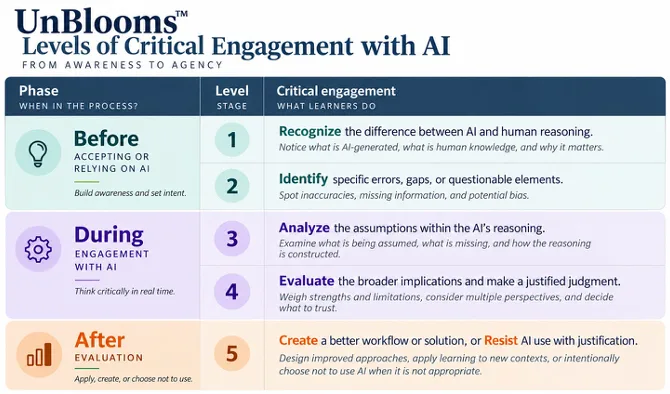
The reframing addresses a critical pedagogical problem with using generative AI for cognitive off-loading: students can appear highly productive by creating with AI while remaining cognitively disengaged and learning nothing. Kassorla's model emphasizes the need to guide students toward genuine comprehension and internalization through stages where AI influence diminishes significantly.
The important role of educational design becomes apparent. Students should preferably be confronted with problems at the verge of constructive friction or a little bit above (see also paragraph 4.4), then engage with generative AI to work on the problem, guided by instructors to really understand what is happening to reach that level of higher order learning.
#3.2AI Literacy in the curriculum?
First, apart from the question about what knowledge and which competencies students need to develop in relation to AI, an important question for educators is: where and when in the curriculum should this development take place? And to what extent is training and objective assessment required? Should it be covered in separate courses? Should it be covered in general academic skills courses? Should it be covered in every course? Is there a learning path that should be developed so that attention is paid to AI literacy in every stage of the curriculum? This requires what we call sufficient 'curriculum literacy'.
First, at the middle-level, start talking to students about the use of generative AI as soon as possible in the program. Incorporate it in their first lecture of the academic year or course, and organize a few specialized meetings about AI. Explain the faculty policy and what students may expect during the program. Also inform them that courses can have different policies about generative AI and that it is up to the teacher and the learning objectives of specific courses. Within a course, different policies can apply to different parts of the course. For example, students may use AI for some (parts of) assignments, but not for others.
Second, moving to the micro-level, you might start having more intensive discussions and tasks in the general academic skills courses or even a separate course. VU CTL has developed an AI-Literacy Companion for Students that contains a lot of information and small tasks that teachers can use to support such a course or specific assignments in such courses. It contains chapters about:
- What generative AI is, what you can do with it, and its limitations and misconceptions;
- How does generative AI hamper learning;
- How to use generative AI effectively: prompt engineering, tool selection and academic integrity;
- How language models work: neural networks, bias, hallucinations and the 'black box' of AI;
- The technical infrastructure behind chat software: interfaces, privacy and data;
- The environmental impact of AI: energy, CO2, water and the Jevons Paradox;
- AI in work and society: changing professions, sectors and socio-economic impact;
- The societal forces around AI: copyright, Big Tech, privacy, discrimination and open versus closed models;
- Students' own AI-aware future: building an AI-literate profile, agency and ethical self-reflection.
Furthermore, the VU Education Lab collected and described a collection of AI Literacy exercises that teachers can scroll through and select for an appropriate time and place to use. It is hoped that the combination of the Companion and these exercises alleviates the tasks of teachers to develop such materials themselves.
Additionally, it is important to consider how attention is given to the question which learning objectives in the program are related to critical thinking within the curriculum. When writing this Companion, the authors felt that AI Literacy cannot be seen separate from knowledge and competency in critical thinking and logic without generative AI. You will read more about this in Chapter 6.
Third, it is expected that discussing and learning about generative AI will be needed in all courses. Not only because of VU Amsterdam policy obligation to inform students how generative AI may be used for learning or working on assignments, but also to show how generative AI impacts the specific topics and disciplines covered in courses. In Chapter 5 you can find a few examples of new course-specific learning objectives that could become part of regular courses.
Finally, if you're a program director, it is an important responsibility that the above-described approach is implemented in a coherent and orchestrated manner. As a program manager you must try, together with the teaching team:
- To establish a vision towards AI in the program and approach for implementing it;
- Determine where and when in the program the specific AI learning objectives are addressed;
- Which assignments students work on;
- If needed, which assignments should be included in the formal assessment program of the curriculum
- Where, how and when to conduct explicit objective tests?
- Where, how and when to bring more formative dialogue into the teaching and learning activities?
This is preferably laid down in a curriculum plan, and teachers in the program should be made aware about this plan and of their role in this learning path.